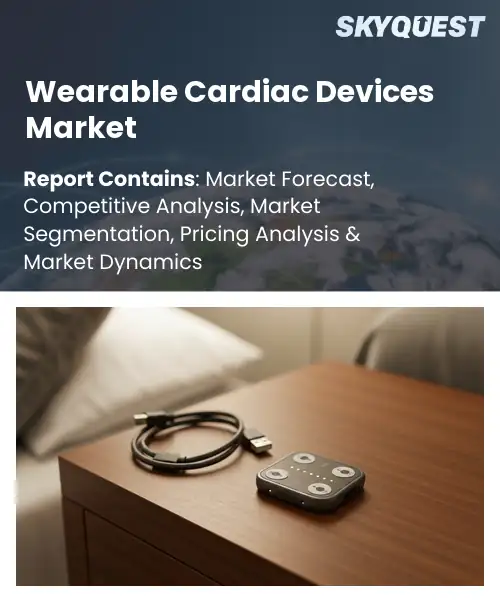
Wearable Cardiac Devices Market
Report ID: SQMIG35A3455
Report ID: SQMIG35A3455
[email protected]
USA +1 351-333-4748
Report ID:
SQMIG35A3455 |
Region:
Global |
Published Date: May, 2026
Pages:
157
|Tables:
117
|Figures:
72


Global Wearable Cardiac Devices Market size was valued at USD 3.52 Billion in 2024 and is poised to grow from USD 3.88 Billion in 2025 to USD 8.52 Billion by 2033, growing at a CAGR of 10.32% during the forecast period (2026-2033).
High prevalence of cardiovascular diseases, increasing adoption of remote patient monitoring, advancements in wearable biosensor technologies, expansion of telemedicine services, and rising demand for continuous cardiac monitoring solutions are driving demand for wearable cardiac devices.
Rising reimbursement support, increasing regulatory approvals for wearable cardiac technologies, and expansion of population screening and chronic disease management programs support steady sales of wearable cardiac devices. Rise in use of ECG patches, smart watches with ECG, chest straps, and remote heart monitors at hospitals, clinics, and home health care facilities is likely to drive market growth. Increased research and development into biosensors, wireless technology, and analytics via cloud computing solutions are expected to help boost the demand for wearable heart monitors. More healthcare service providers and device companies are looking to incorporate wearable monitoring solutions with telemedicine systems, EMR systems, and patient monitoring solutions. Increasing need for early detection and continuous monitoring of cardiac conditions around the world coupled with rising prevalence of arrhythmias, heart failure, and other cardiovascular disorders are expected to primarily drive wearable cardiac devices market growth.
On the contrary, high costs associated with advanced wearable monitoring systems, concerns regarding data privacy and cybersecurity, risk of inaccurate readings and false alerts, and regulatory challenges related to medical-grade wearable devices are anticipated to slow down wearable cardiac devices market penetration in the future.
How is AI Enhancing Predictive Monitoring In Wearable Cardiac Devices?
Predictive monitoring technology in wearable cardiac devices involves the use of continuous physiological monitoring and artificial intelligence to recognize patterns that might indicate potential risks of heart attacks or deterioration of the cardiac condition well before a critical event happens. The industry has been progressively moving away from just issuing episodic alerts to providing continuous and actionable cardiac monitoring through integration into the remote patient monitoring framework. Medical-grade mobile ECG wearable devices and AI-powered analytics software platforms are becoming common among manufacturers to enhance accuracy and limit unnecessary false alerts.
Market snapshot - (2026-2033)
Global Market Size
USD 3.52 Billion
Largest Segment
Holter Monitors
Fastest Growth
Implantable Loop Recorders
Growth Rate
10.32% CAGR
To get more insights on this market click here to Request a Free Sample Report
Global wearable cardiac devices market is segmented by device type, application, technology, end-user, and region. Based on device type, the market is segmented into holter monitors, cardiac event monitors, implantable loop recorders, and wearable cardioverter defibrillators (WCD). Based on application, the market is segmented into arrhythmia detection, atrial fibrillation monitoring, and heart failure management. Based on technology, the market is segmented into Bluetooth-enabled and cellular-enabled. Based on end-user, the market is segmented into hospitals, cardiology clinics, and home care. Based on region, the market is segmented into North America, Europe, Asia Pacific, Latin America, and Middle East & Africa.
The implantable loop recorders segment is forecasted to account for the highest global wearable cardiac devices market share in the future. These types of devices offer continuous and prolonged monitoring of heart rhythms, which allow detection of rare or asymptomatic arrhythmias with high confidence. The convenience associated with being implantable, coupled with extended monitoring periods, help reduce any diagnostic doubts and simplify clinicians’ workflow, leading to popularity among electrophysiologists. Improved technology such as reduced size, better batteries, and remote reviewing systems help improve the diagnostic capability.
However, wearable cardioverter defibrillators are emerging as the fastest-growing segment as per this wearable cardiac devices industry analysis. Safety of high-risk patients without invasion and increased comfort levels of clinicians with regards to the application of external devices temporarily creates a new business scope. Improvements in accuracy of sensors, user-friendly design of devices, and alerts generated by such devices to a platform promote their usage.
The Bluetooth-enabled segment is estimated to spearhead the global wearable cardiac devices market revenue generation across the study period. This connectivity technology provides seamless connectivity for smartphones with low power consumption, which are compatible with constant monitoring of cardiac activities through wearables. Its compatibility with consumer devices and applications ensures that it will be easy to integrate into the patients' routines, while economical modules and development communities make it easy to produce products compatible with the EHRs and telehealth systems used by providers.
Nevertheless, cellular-based services represent the fastest-growing segment due to built-in connectivity for uploading data into the cloud, independent monitoring, and triggering alerts in real time without the use of smartphones. The collaboration between carriers and the adoption of telemedicine modules have made possible telehealth workflows and increased the demand for remote monitoring.
To get detailed segments analysis, Request a Free Sample Report
Supportive clinical infrastructure, advanced device innovation, and strong payer and regulatory environments are helping this region hold sway over others. Established clinical research networks, collaborative relationships between technology providers and healthcare systems, along with a high level of participation by both physicians and patients, drive significant demand for continuous and remote cardiac monitoring devices. In addition, established reimbursement models and alignment between medical guidelines and actual patient care make it easier to incorporate these devices into clinical practice. In addition, an abundance of specialized cardiac centers and digital health incubators facilitates the generation of early clinical evidence related to these devices. Together with well-defined regulatory clarity and effective post-market surveillance, all these factors combine to create an environment in which stakeholders believe strongly.
Integrated clinical networks, extensive digital health adoption, and innovation hubs that accelerate wearable cardiac devices validation and clinician uptake in the United States. Clinician endorsement and patient awareness about remote monitoring enhance adoption in standard heart disease management practices. Large cardiac-specific centers facilitate monitoring projects and collaboration with tech companies ensures rapid evolution of both algorithms and sensors. The right reimbursement and regulatory structures incentivize commercialization.
Sales of wearable cardiac devices in Canada are shaped by a funded health system that emphasizes equitable access and evidence-based adoption of innovations. Emphasis on interoperability and training for clinicians is essential in adoption, and province-specific financial incentives drive the interest of healthcare managers. Collaboration between academic health centers and regional health authorities is used to develop pilots for remote cardiac monitoring, and digital health efforts promote adoption of wearables’ data into patient management practices.
Harmonized regulatory frameworks, strong clinical research networks, and proactive national health strategies that prioritize early detection are helping boost the adoption of wearable cardiac devices in the region. Initiatives that promote cross-border data sharing and that require interoperability between systems will support widespread adoption of these technologies among healthcare providers. Additionally, advocates for patients and seniors are placing added emphasis on the need to provide continuous cardiac monitoring at a national level and will continue to elevate the priority of doing so. In many markets, there are established reimbursement structures, as well as pilot programs, that will encourage payers to reimburse these devices. Further, clinician advocates and telemedicine will provide additional opportunities for the regular use of wearables in ambulatory care, and at home. Increasing focus on value-based care and health technology assessment is generating interest and investment in the use of wearables that have clinical benefits and the ability to integrate into existing systems.
Strong medical technology industry and deep clinical trial capabilities that support rigorous evidence generation shapes demand for wearable cardiac devices in Germany. Industry and academia partnerships help advance and scale up solutions through regional care networks. Pilot deployment and clinical assessment benefit from integrated hospital network structures and dedicated cardiology facilities. Manufacturing experience helps to manufacture on-site, and health technology assessment and funding mechanisms facilitate implementation in tested applications.
Proactive national health systems focus on digital transformation and high-profile remote monitoring initiatives, which support sales of wearable cardiac devices in the United Kingdom. Interoperability and physician engagement enhance adoption rates in both primary and secondary healthcare sectors. Effective academic hospital networks and health technology assessment processes facilitate evidence-based integration into clinical pathways. Medtech entrepreneurship and sectoral pilot projects promote quick iterations.
The increasing popularity of public health programs and the rising involvement of hospitals in digital cardiology is contributing to the increased use of wearable heart monitors in France. The startup ecosystem and incubator movement drive innovations in sensing technology and analysis. Well-developed clinical research facilities and industrial cooperation promote validation and physician involvement. Focus of the country on prevention leads to pilot studies outside hospitals for wearable cardiac devices.
Advanced electronics manufacturing capabilities, strong consumer electronics ecosystems, and increasing collaboration between technology firms and healthcare providers are boosting sales of wearable cardiac devices in the region. Programs offered by government organizations and partnerships between private and public sectors have played a key role in the development of clinical trials for the implementation of tele-health technologies. With active participation of clinicians and further development of telemedicine, there arise new possibilities for remote heart monitoring. Companies can take advantage of their strategic alliances with leading global medical device providers and fasten the adoption of solutions in different health care environments. Emerging pilots in reimbursement, along with new regulatory guidelines, ensure better market access for companies, while the importance given to data management builds trust among the stakeholders. Moreover, the presence of a huge reservoir of talented professionals specializing in artificial intelligence and signal processing enables companies to develop advanced analytics solutions that enhance diagnostics and clinical decision-making.
Wearable cardiac device demand in Japan benefits from advanced electronics manufacturing and a healthcare focus on managing chronic cardiovascular conditions amid an aging population. Integrating telemedicine technology and EMR makes it easier to adopt this new technology both within hospitals and homes. Research centers within the region contribute to innovation that is continuous. Cooperation between technological and medical companies helps make designs reliable. Robust regulation and focus on safety build clinician confidence.
A robust electronics supply chain, expertise in sensors and miniaturization are helping shape wearable cardiac device demand in South Korea. The focus on data-driven diagnosis and machine learning provides better analytics potential, enabling seamless incorporation of devices into health workflows. Collaboration among technology firms, hospitals, and institutes ensures speedy testing and development of algorithms. Government backing for digital health innovation, combined with positive telemedicine policy developments, opens up more options for implementation.
To know more about the market opportunities by region and country, click here to
Buy The Complete Report
Advancements In Remote Cardiac Monitoring
Integration With Consumer Wearables
Regulatory and Reimbursement Complexity
Data Privacy and Security Concerns
Request Free Customization of this report to help us to meet your business objectives.
Competitive landscape is characterized by consolidation and technology driven partnerships that accelerate market entry and regulatory reach, with M&A activity such as Boston Scientific's acquisition of Preventice and major venture rounds for innovators like Element Science pushing incumbents to pursue collaborations with research hubs and health systems to differentiate offerings and capture clinical pilots.
SkyQuest’s ABIRAW (Advanced Business Intelligence, Research & Analysis Wing) is our Business Information Services team that Collects, Collates, Correlates, and Analyses the Data collected by means of Primary Exploratory Research backed by robust Secondary Desk research.
As per SkyQuest analysis, rising prevalence of cardiovascular diseases and increasing adoption of remote patient monitoring solutions are anticipated to drive the demand for wearable cardiac devices going forward. However, concerns regarding data privacy and cybersecurity and risk of inaccurate readings and false alerts are slated to slow down the adoption of wearable cardiac devices in the future. North America is slated to spearhead the demand for wearable cardiac devices owing to advanced healthcare infrastructure and high adoption of digital health and telemedicine technologies. Development of AI-enabled predictive monitoring platforms and increasing integration of wearable cardiac devices with telehealth and electronic medical record systems are anticipated to be key trends driving the wearable cardiac devices industry in the long run.
| Report Metric | Details |
|---|---|
| Market size value in 2024 | USD 3.52 Billion |
| Market size value in 2033 | USD 8.52 Billion |
| Growth Rate | 10.32% |
| Base year | 2024 |
| Forecast period | (2026-2033) |
| Forecast Unit (Value) | USD Billion |
| Segments covered |
|
| Regions covered | North America (US, Canada), Europe (Germany, France, United Kingdom, Italy, Spain, Rest of Europe), Asia Pacific (China, India, Japan, Rest of Asia-Pacific), Latin America (Brazil, Rest of Latin America), Middle East & Africa (South Africa, GCC Countries, Rest of MEA) |
| Companies covered |
|
| Customization scope | Free report customization with purchase. Customization includes:-
|
To get a free trial access to our platform which is a one stop solution for all your data requirements for quicker decision making. This platform allows you to compare markets, competitors who are prominent in the market, and mega trends that are influencing the dynamics in the market. Also, get access to detailed SkyQuest exclusive matrix.
Table Of Content
Executive Summary
Market overview
Parent Market Analysis
Market overview
Market size
KEY MARKET INSIGHTS
COVID IMPACT
MARKET DYNAMICS & OUTLOOK
Market Size by Region
KEY COMPANY PROFILES
Methodology
For the Wearable Cardiac Devices Market, our research methodology involved a mixture of primary and secondary data sources. Key steps involved in the research process are listed below:
1. Information Procurement: This stage involved the procurement of Market data or related information via primary and secondary sources. The various secondary sources used included various company websites, annual reports, trade databases, and paid databases such as Hoover's, Bloomberg Business, Factiva, and Avention. Our team did 45 primary interactions Globally which included several stakeholders such as manufacturers, customers, key opinion leaders, etc. Overall, information procurement was one of the most extensive stages in our research process.
2. Information Analysis: This step involved triangulation of data through bottom-up and top-down approaches to estimate and validate the total size and future estimate of the Wearable Cardiac Devices Market.
3. Report Formulation: The final step entailed the placement of data points in appropriate Market spaces in an attempt to deduce viable conclusions.
4. Validation & Publishing: Validation is the most important step in the process. Validation & re-validation via an intricately designed process helped us finalize data points to be used for final calculations. The final Market estimates and forecasts were then aligned and sent to our panel of industry experts for validation of data. Once the validation was done the report was sent to our Quality Assurance team to ensure adherence to style guides, consistency & design.
Analyst Support
Customization Options
With the given market data, our dedicated team of analysts can offer you the following customization options are available for the Wearable Cardiac Devices Market:
Product Analysis: Product matrix, which offers a detailed comparison of the product portfolio of companies.
Regional Analysis: Further analysis of the Wearable Cardiac Devices Market for additional countries.
Competitive Analysis: Detailed analysis and profiling of additional Market players & comparative analysis of competitive products.
Go to Market Strategy: Find the high-growth channels to invest your marketing efforts and increase your customer base.
Innovation Mapping: Identify racial solutions and innovation, connected to deep ecosystems of innovators, start-ups, academics, and strategic partners.
Category Intelligence: Customized intelligence that is relevant to their supply Markets will enable them to make smarter sourcing decisions and improve their category management.
Public Company Transcript Analysis: To improve the investment performance by generating new alpha and making better-informed decisions.
Social Media Listening: To analyze the conversations and trends happening not just around your brand, but around your industry as a whole, and use those insights to make better Marketing decisions.
REQUEST FOR SAMPLE
 REQUEST FREE CUSTOMIZATION
Global Wearable Cardiac Devices Market size was valued at USD 3.52 Billion in 2024 and is poised to grow from USD 3.88 Billion in 2025 to USD 8.52 Billion by 2033, growing at a CAGR of 10.32% during the forecast period (2026-2033).
Competitive landscape is characterized by consolidation and technology driven partnerships that accelerate market entry and regulatory reach, with M&A activity such as Boston Scientific's acquisition of Preventice and major venture rounds for innovators like Element Science pushing incumbents to pursue collaborations with research hubs and health systems to differentiate offerings and capture clinical pilots. 'iRhythm Technologies', 'Zoll Medical (Asahi Kasei)', 'BioTelemetry (Philips)', 'Medtronic plc', 'Abbott Laboratories', 'Boston Scientific', 'CardioNet (BioTelemetry)', 'GE Healthcare', 'Biobeat Technologies', 'AliveCor (KardiaMobile)', 'SHL TeleMedicine', 'VitalConnect', 'Preventice Solutions', 'InfoSonics Corporation', 'Cardiac Science'
Continuous improvements in sensor accuracy, signal processing algorithms, and low-power electronics have enabled wearable cardiac devices to provide reliable, continuous remote monitoring that clinicians trust for early arrhythmia detection and ongoing heart failure management. These technical enhancements reduce false positives and ease integration into clinical workflows, fostering clinician acceptance and referral. Seamless connectivity with telehealth platforms and electronic health records simplifies data sharing, enabling proactive patient management and follow-up, which in turn encourages healthcare providers and patients to adopt wearable cardiac monitoring as part of routine care.
Integration With Telehealth Ecosystems: Integration of wearable cardiac devices into telehealth platforms is accelerating adoption by enabling continuous remote monitoring and streamlined clinician workflows. Platforms are focusing on interoperability, secure data exchange, and clinical decision support to facilitate timely interventions and care coordination across settings. Partnerships between device makers and virtual care providers are creating integrated service models that improve patient engagement and enable longitudinal management. Emphasis on seamless clinician interfaces and workflow integration is positioning wearables as core components of cardiac care pathways.
Why does North America Dominate the Global Wearable Cardiac Devices Market? |@12


Want to customize this report? This report can be personalized according to your needs. Our analysts and industry experts will work directly with you to understand your requirements and provide you with customized data in a short amount of time. We offer $1000 worth of FREE customization at the time of purchase.
Feedback From Our Clients


 USA (+1) 351-333-4748

