Our Clients

  • Schineder Electric
  • KSIA - Korea Semiconductor Industry Association
  • Hitachi Astemo Limited
  • Samsung Electronics
  • Halvo holdings
  • NTT corporation
  • AGC Inc
  • Siemens AG
  • Unilever
  • Merck Pharmaceuticals
  • Atlas Copco
  • Hologic - Medical Technology company
  • Novartis
  • Henkel
  • Reckitt
  • Schineder Electric
  • KSIA - Korea Semiconductor Industry Association
  • Hitachi Astemo Limited
  • Samsung Electronics
  • Halvo holdings
  • NTT corporation
  • AGC Inc
  • Siemens AG
  • Unilever
  • Merck Pharmaceuticals
  • Atlas Copco
  • Hologic - Medical Technology company
  • Novartis
  • Henkel
  • Reckitt
  • FAQs

    Biomedical Textiles Market size was valued at USD 18.92 Billion in 2024 and is poised to grow from USD 20.19 Billion in 2025 to USD 33.91 Billion by 2033, growing at a CAGR of 6.7% during the forecast period (2026–2033).

    The competitive environment of the global Biomedical Textiles market is dynamic and characterized by the presence of a mix of well-established brands, emerging players, and niche producers. Innovation is a key competitive factor. Established organizations within the industry leverage techniques inclusive of product innovation, strategic partnerships, and mergers and acquisitions to strengthen their market position. Additionally, the market is witnessing elevated opposition from local and neighborhood producers supplying cost-powerful options. 'Royal DSM (Netherlands) ', 'Johnson & Johnson (United States) ', 'Medtronic (United States) ', 'Cardinal Health (United States) ', 'Integra LifeSciences Corporation (United States) ', 'Smith & Nephew (United Kingdom) ', 'Medline (United States) ', 'Paul Hartmann AG (Germany) ', 'BSN Medical (Germany) ', 'ATEX Technologies (United States) ', 'Elkem Silicones (Germany) ', 'Bally Ribbon Mills (United States) ', 'US Biodesign (United States) ', 'Nitto Denko Corporation (Japan) ', 'Kimberly-Clark (United States) ', 'Mölnlycke Health Care (Sweden) ', '3M Company (United States) ', 'Ahlstrom-Munksjö (Sweden) ', 'Freudenberg & Co. Kommanditgesellschaft (Germany) ', 'Secant Group LLC (United States)'

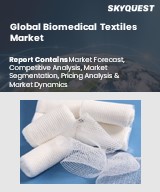
    Biomedical garments have been increasingly used by surgeons and physicians as a way to replace and support damaged body parts. Biomedical textiles find applications in other synthetic tissues, fibers and grafts. Synthetic fabric implants are used as artificial arteries or vessels inserted into the heart to replace the first artery or artery that is blocked or weakened by muscle or replacing the 6 mm to 1 cm grafts. Pharmaceutical textiles are also used in a variety of orthopedic procedures, such as sutures, joint and tendon grafts, reconstructive devices, and spinal dressings.

    Development of Healthcare Services to Increase Market Growth: With increasing healthcare budgets, increasing healthcare literacy, and increasing healthcare costs, the growing healthcare industry is likely to provide a global portfolio of biopharmaceuticals the business has grown during the forecast period. The increasing incidence of accidents, lifestyle diseases and common infectious diseases calls for technological innovation to facilitate medical procedures and, it is expected to market great results for biomedical textiles manufacturers in the healthcare industry.

    North America is expected to dominate the global market, owing to the highly developed healthcare sector in the US, and the continued investment in this sector to develop the medical technology sector over the years. Moreover, with increasing obesity issues in the country, various diseases affecting the population, and various therapeutic needs in the country, textiles for pharmaceutical a the demand for applications is increasing.

    Feedback From Our Clients

    Global Biomedical Textiles Market

    Report ID: SQMIG15A2431

    $5,300
    BUY NOW


