Our Clients

  • Schineder Electric
  • KSIA - Korea Semiconductor Industry Association
  • Hitachi Astemo Limited
  • Samsung Electronics
  • Halvo holdings
  • NTT corporation
  • AGC Inc
  • Siemens AG
  • Unilever
  • Merck Pharmaceuticals
  • Atlas Copco
  • Hologic - Medical Technology company
  • Novartis
  • Henkel
  • Reckitt
  • Schineder Electric
  • KSIA - Korea Semiconductor Industry Association
  • Hitachi Astemo Limited
  • Samsung Electronics
  • Halvo holdings
  • NTT corporation
  • AGC Inc
  • Siemens AG
  • Unilever
  • Merck Pharmaceuticals
  • Atlas Copco
  • Hologic - Medical Technology company
  • Novartis
  • Henkel
  • Reckitt
  • FAQs

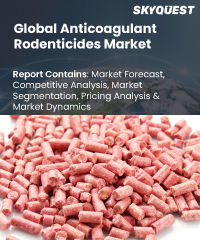
    Global Anticoagulant Rodenticides Market size was valued at USD 763.5 Million in 2024 and is poised to grow from USD 787.93 Million in 2025 to USD 1013.74 Million by 2033, growing at a CAGR of 3.2% during the forecast period (2026–2033). 

    Due to the industry's intense competition, diversified product offering, and wide geographic distribution of vendors. The manufacturers are always working to develop a variety of active components for anticoagulant-based rodent control products. For instance, BASF SE introduced the anticoagulant rodenticide "Leo Miao" in May 2021 in order to manage rats in the livestock industry. In an effort to keep up with the need for a sustainable future, manufacturing companies are making a lot of effort to broaden their product offerings and provide products derived from natural sources. 'BASF SE (Germany) ', 'Bayer AG (Germany) ', 'Syngenta (Switzerland) ', 'Rentokil Initial PLC (UK) ', 'Neogen Corporation (USA) ', 'PelGar International (UK) ', 'Liphatech (USA) ', 'Bell Laboratories Inc. (USA) ', 'JT Eaton & Co., Inc. (USA) ', 'Impex Europa S.L. (Spain) ', 'SenesTech, Inc. (USA) ', 'Anticimex (Sweden) ', 'Ecolab Inc. (USA) ', 'Terminix (USA) ', 'Rollins, Inc. (USA) ', 'Truly Nolen (USA) ', 'Orkin (USA) ', 'Killgerm Group (UK) ', 'Pelsis Ltd. (UK) ', 'Ensystex (USA) '

    A growing realization of the advantages of using anticoagulant rodenticides, such as their effectiveness in controlling rodents, their lasting effects, and their minimal toxicity to organisms other than the target.

    As awareness about the environmental impact of anticoagulant rodenticides increases, there has been a growing demand for sustainable and non-toxic pest control methods. This has led to the development and adoption of alternative pest control methods such as integrated pest management, non-toxic baits, and physical exclusion techniques.

    North America dominates the market for anticoagulants rodenticides due to the high rodent population densities that cause an increase in rodent-borne diseases, such as Hantavirus infections and its human transmission. According to the CDC, there are a lot of rats in developed nations that can spread the hantavirus. Due to the numerous producers and there are strict hygiene standards, the market for anticoagulants and rodenticides is also growing.

    Feedback From Our Clients

    Global Anticoagulant Rodenticides Market

    Report ID: SQMIG15C2033

    $5,300
    BUY NOW


